Categories
Blog Tours book reviews Emma's Anticipated Treasures

BLOG TOUR REVIEW: A Girl’s Guide To Winning the War

Published July 25th, 2024 by Headline
Historical Fiction, Historical Romance, Military Romance

Welcome to my stop on the blog tour for this heartwarming and uplifting novel. Thanks to Anne at Random Things Tours for the invitation to take part and to Headline for sending me a copy of the book in exchange for my honest review.

********

ABOUT THE BOOK:

‘A heart-warming tale about resilience, friendships and family, and the inestimable power of the written word’ RUTH HOGAN

‘A heart-warming depiction of strong female friendships tested by suffering – Annie Lyons really is the queen of the wartime saga’ CLARE CHAMBERS
___________

Can two young women and one book change the course of war?

1940. Whip-smart librarian Peggy Sparks is determined to make sure that her brother Joe returns from the frontline to their London home, which they share with their beloved mother and grandmother. So when she is offered a once-in-a-lifetime job at the heart of the war effort, Peggy jumps at the prospect of making a real contribution to her country.

But when she finds herself working under the fanciful socialite Lady Marigold Cecily, Peggy discovers that those around her are more keen on dancing at the Café de Paris than on ending the war. Writing accounts of her daily life is the only thing keeping Peggy’s hopes alive. But when she finds her inner-most thoughts accidentally published by the Ministry of Information, Peggy realises she needs Marigold’s help to save her job, and to bring her brother home . . .

From the author of The Air Raid Book Club comes a powerful tale of unexpected friendship, community and two remarkable women who change the course of the war. Full of heart, emotion and drama, it is the perfect uplifting story for fans of Kate Thompson and Natasha Lester.

********

MY REVIEW:

“This wasn’t an unusual story. In fact, it was the story of millions of women living through the war along the length and breadth of the country… This was about women fighting and surviving , not on the battlefields but in their own back yards.”

Heartwarming, compelling and uplifting, A Girl’s Guide To War is a glorious tale of courage, strength, friendship, and family. Of finding light in the darkest times. And of the power of books.

London, 1940. Librarian Peggy Sparks lives with her mum, Alice, grandmother, Emily, pregnant sister-in-law, Flo, and young niece, Nancy. Her twin brother, Joe, is serving on the frontline and she is determined to see that he returns home safely. So, when she is offered a job as a proof-reader at The Ministry of Information, she jumps at the chance, recognising this once-in-a-lifetime opportunity to not only make a contribution to her country, but fulfil her promise to bring Joe home. It is there she meets Lady Marigold Cecily, a workshy aristocrat. But the pair slowly become friends before working together to publish books that are a vital part of the war effort. 

As a bookworm who loves reading historical fiction set in World War II this book was made for me. From its opening line I knew I’d found a book and character I’d street and from its opening lines I knew I’d found a book and character I’d love. Annie Lyons shows us the realities of war through the eyes of women and has filled the book with strong female characters of all ages, their bonds of community strengthened by the struggles and heartache of war. Their bravery is evident in the small things they do while living their lives each day. It is humbling, honest and raw, but also written with deep compassion and sensitivity and I was glued to the pages.

Peggy Sparks is a fantastic protagonist. Smart, determined and kind, I felt an immediate connection to this family-orientated, lifelong bookworm. When we meet her, Peggy is keeping a written account of how the war affects her daily life but her job at the Ministry offers the chance to do this, and more, on a greater scale. It is at the Ministry she meets Lady Marigold, and the pair could not be more different. Peggy is a homebody and hard worker, while Marigold is always late and prefers nights out at the Cafe de Paris. But the pair slowly form a friendship and work together to create and publish books that are an important part of the Ministry’s war effort. I loved their friendship and how they taught each other so much about life from another perspective. Central to the story is the close relationship between Peggy and her family. They may not have a lot financially, but they have things that money can’t buy, such as love and togetherness, and the bond between them radiates from the pages. I loved reading their scenes together and had a real soft spot for little Nancy who is a real firecracker that often dropped pearls of wisdom. Another brilliant character was Emily, Peggy’s grandmother and matriarch of the family. I loved this no-nonsense woman and she often had me laughing with her quips. Peggy’s twin brother may have been away at war but he is made flesh and blood through the letters he writes to Peggy. I thought this was a clever way to make him real while also displaying the power of writing. 

Books are an integral part of this story and both they and the written word are woven into every facet of the story. All book lovers know the power, magic and joy of books, but it felt extra special seeing the power they had during the war not only as a tool for information, but also in boosting morale. I enjoyed reading about the pamphlets and books that were published by the Ministry during the war and how they were seen as a vital way of boosting morale. It was fascinating to read about the publishing process and I enjoyed learning through historical fiction once again. Despite knowing quite a lot about this era I had somehow never considered or come across paper rationing so I enjoyed learning more about that and the difficulties faced by the publishing industry at the time. I also enjoyed reliving the connection we get through letters, a format that isn’t often used in today’s age but was vital at a time when there was no other way of communicating with loved ones serving on the frontline.

Delightful, moving and hopeful, this is a must-read for book lovers and fans of historical fiction.

Rating: ✮✮✮✮✰

********

MEET THE AUTHOR:
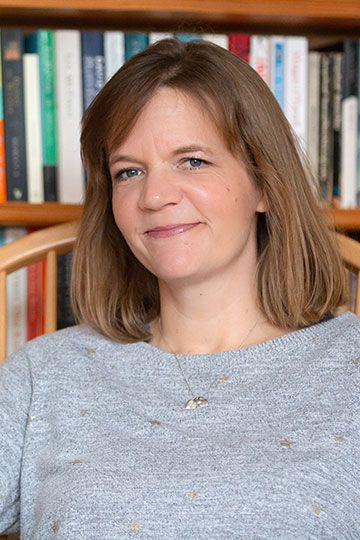
After a career in bookselling and publishing, Annie Lyons published numerous books in the U.K. and The Brilliant Life of Eudora Honeysett in the U.S. When not working on her novels, she teaches creative writing. She lives in south-east London with her husband and two children.

********

BUY THE BOOK:

Bookshop.org* | Waterstones* | Amazon*
*These are affiliate links

********

Please check out the reviews from the other bloggers taking part in the tour.
Categories
Blog Tours Q&A

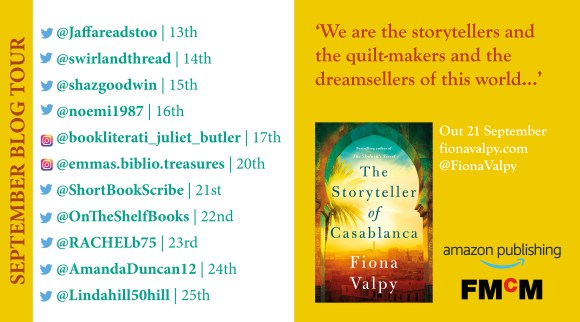
Blog Tour: Q&A with Fiona Valpy

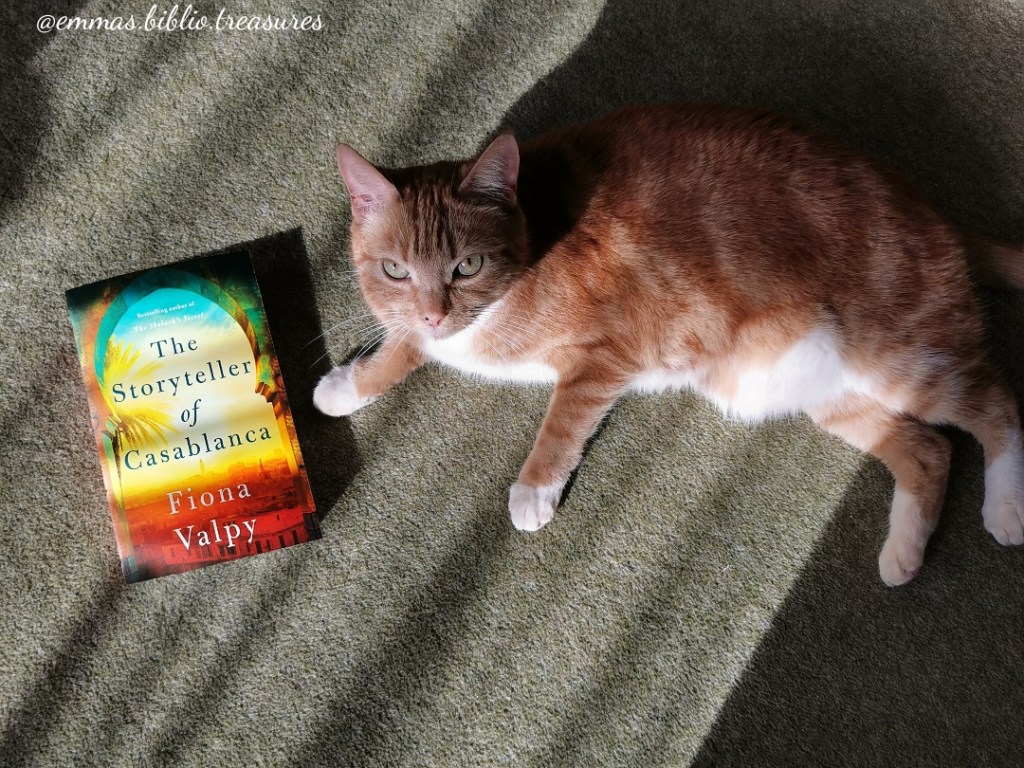
Happy Monday Bibliophiles! Today I’m delighted to be sharing a Q&A with author Fiona Valpy as part of the blog tour for her latest novel, The Storyteller of Casablanca, which is published tomorrow.

What drew you to writing? Had you always wanted to become a novelist?

From early childhood I’d always been an avid reader and lived in a home filled with books. Often, I would finish a book and think ‘I wish I could have written that’, but all my time was filled with my career and motherhood until we made a move to France. There, I found both inspiration and the time to write my first books. Now I can’t imagine my life without writing.

What made you want to shift from contemporary fiction to historical fiction?

While the countryside and contemporary culture of France were the initial inspiration for my writing, the country’s history – especially the legacy of being occupied during World War 2 – are all-pervasive and soon claimed my attention.

I still wanted to include a contemporary slant to my books, though, and so I began writing dual timeline novels. There’s a challenge in finding the connection between two separate eras and pulling them together in a way that’s convincing. I love the sense of interweaving two storylines which may seemed disconnected at first, but which later converge. And of course, our histories are such a part of who we are today.

What is it about the Second World War that you think readers are so fascinated by?

It’s still just within living memory for some, although of course that generation is slipping away fast and so there’s a sense of urgency in recording their first-hand testimonies and making sure their voices will still be heard as the years go by. We’ve also reached new milestones in terms of documents being de-classified and information released, allowing previously unknown facts to come to light and enabling new interpretations of wartime events.

While subsequent generations have been fortunate to live in a time of peace, life can still be challenging, and I believe we can learn a great deal from understanding how others have suffered and faced up to difficulties. In particular, in some ways the war gave women an opportunity to break free of the limitations society placed on them and prove themselves in new ways, playing their part in the fight against oppression.

I believe women are incredibly resilient and have qualities that are absolutely vital in today’s world – not just strength and endurance, but also kindness and compassion. I hope my books help women to see themselves in this light.

What research did you do for The Storyteller of Casablanca?

I’d organised a research trip to Morocco but the global pandemic stymied those plans. So I had to find other ways to fill in the gaps and ensure I could still transport the reader to that other time and place. I studied travel guides and pored over maps, but also read more widely and around my subject, including novels by Driss ChraÏbi (The Simple Past), Paul Bowles (The Sheltering Sky) and Anthony Doerr’s Africa-based short stories (The Shell Collector). Meredith Hindley’s book Destination Casablanca offered a wealth of insight into the city during the war years and Hal Vaughn’s FDR’s 12 Apostles was a useful source of detail about the establishment of espionage networks in North Africa prior to US invasion in November 1943.

Videos on YouTube helped me visit the sights and souks, and the internet offered up additional information on some of the real-life characters that appear in the book, including the inspirational Josephine Baker and Hélêne Cazês-Bénatar. Other such characters, like Dorothy Ellis, proved to be frustratingly elusive despite all my research efforts though, so I hope I have done her justice.

In The Storyteller of Casablanca there are many different stories told in different ways. Can you tell us a little more about this?

I’ve included storytelling in many different forms in the book – there’s everything from Charlotte Bronte’s Jane Eyre and the murder mysteries of Dorothy L. Sayers, La Fontaine’s Fables, and traditional African and Berber Folk Stories, to the Tales from the Thousand and One Nights.

It’s one of the key themes of the book. I wanted to explore how the stories we tell are an important part of our history and at the same time can inspire and shape our future, as well as illustrating the common ground between different cultures in the past and present. There’s a universality in the human need to tell our stories and make our voices heard that transcends borders, cultures, race, religion, age and gender.

What’s next for you?

I’m working on a novel set in Italy during World War 2 at the moment, as well as revising my first three books (The French for… series of contemporary novels) which are to be re-issued in the coming year, so my writing continues to keep my busy!

********

I don’t know about you, but this interview has made me even more excited to read The Storyteller of Casablanca. Still not sure? Well here’s some more info to whet you’re appetite…

SYNOPSIS:

In this evocative tale from the bestselling author of The Dressmaker’s Gift, a strange new city offers a young girl hope. Can it also offer a lost soul a second chance?

Morocco, 1941. With France having fallen to Nazi occupation, twelve-year-old Josie has fled with her family to Casablanca, where they await safe passage to America. Life here is as intense as the sun, every sight, smell and sound overwhelming to the senses in a city filled with extraordinary characters. It’s a world away from the trouble back home—and Josie loves it.

Seventy years later, another new arrival in the intoxicating port city, Zoe, is struggling—with her marriage, her baby daughter and her new life as an expat in an unfamiliar place. But when she discovers a small wooden box and a diary from the 1940s beneath the floorboards of her daughter’s bedroom, Zoe enters the inner world of young Josie, who once looked out on the same view of the Atlantic Ocean, but who knew a very different Casablanca.

It’s not long before Zoe begins to see her adopted city through Josie’s eyes. But can a new perspective help her turn tragedy into hope, and find the comfort she needs to heal her broken heart?

You can buy the book here

********

MEET THE AUTHOR:

Fiona is an acclaimed number 1 bestselling author, whose books have been translated into more than twenty different languages worldwide.

She draws inspiration from the stories of strong women, especially during the years of World War II. Her meticulous historical research enriches her writing with an evocative sense of time and place.

She spent seven years living in France, having moved there from the UK in 2007, before returning to live in Scotland. Her love for both of these countries, their people and their histories, has found its way into the books she’s written.

********

Please check out the reviews from the other bloggers taking part in the tour.
Thank you to FMcM Associates for the invitation to take part in the tour and the gifted copy of the book. And a special thank you to Fiona Valpy for taking the time to answer these questions.

Thanks for reading Bibliophiles ☺️ Emma xxx